Website performance is no longer just a technical consideration, it has become a critical business factor that influences search visibility, user satisfaction, and conversion rates. As Google continues prioritizing user experience signals, businesses investing in page speed SEO improvements are gaining advantages in both rankings and customer engagement.
In 2026, website visitors expect pages to load almost instantly. Even small delays can increase bounce rates, reduce conversions, and negatively affect search performance. Understanding how website speed and Core Web Vitals influence both SEO and user behavior can help businesses create faster, more effective digital experiences.
Modern internet users have become increasingly impatient.
Research consistently shows that:
Google’s own research has shown that as page load time increases from one second to three seconds, the probability of a visitor leaving rises significantly. This makes website performance a critical factor for both customer retention and search visibility.
Businesses that prioritize speed create better experiences while simultaneously improving their search performance.
One of the most frequently asked questions remains: is page speed a ranking factor google core web vitals?
The answer is yes, but with important context.
Google officially incorporates page experience signals into its ranking systems through Core Web Vitals. However, Google has repeatedly emphasized that content relevance and quality remain stronger ranking factors. Page experience often acts as a competitive advantage when multiple pages offer similar content quality.
In practical terms:
Website speed should therefore be viewed as both a ranking factor and a business performance factor.
Google introduced Core Web Vitals to measure real-world user experiences.
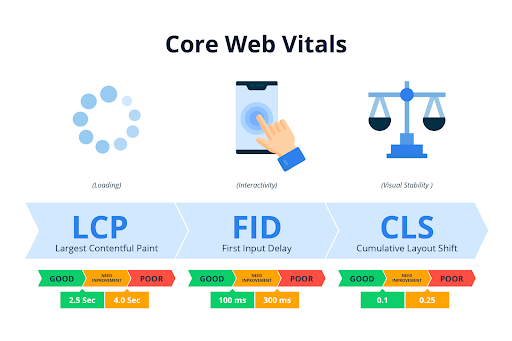
Today, three primary metrics define website performance:
LCP measures how quickly the primary visible content loads.
Google recommends:
A fast LCP ensures users can immediately access important information without unnecessary waiting.
In 2024, Google replaced First Input Delay with INP.
This metric measures how quickly a website responds when users interact with it.
Recommended target:
Fast interaction times create a smoother browsing experience and reduce user frustration.
CLS measures visual stability.
Users become frustrated when buttons, images, or text unexpectedly move during loading.
Google recommends:
Stable layouts improve usability and increase customer confidence.
Strong website user experience depends heavily on performance.
When websites load slowly, users often experience:
Research consistently shows that slower websites experience higher abandonment rates.
Users frequently leave websites when:
Higher bounce rates can indirectly affect search performance through reduced engagement signals.
Slow websites create perceptions of:
Customer expectations continue to rise, making performance optimization essential.
Since Google uses mobile-first indexing, mobile speed has become especially important.
Mobile users often experience:
Poor mobile experiences can significantly impact business performance.
The relationship between performance and SEO extends beyond rankings alone.
Strong technical SEO performance benefits from faster websites because:
Google allocates a crawl budget to every website.
When pages load faster:
Slow websites can reduce crawl efficiency and limit visibility opportunities.
Search engines evaluate behavioral signals such as:
Fast websites naturally support stronger user engagement.
Google representatives have repeatedly stated that page experience often serves as a differentiator when competing pages offer similar relevance and quality.
This creates a direct relationship between performance and competitive search visibility.
There has been considerable debate regarding core web vitals seo impact.
Industry experts generally agree on several conclusions:
As Google’s former Search engineering leadership has explained, Core Web Vitals represent one of the few ranking factors that website owners can directly measure and improve.
Rather than chasing perfect scores, businesses should focus on delivering genuinely fast and usable experiences.
Website speed affects more than search traffic.
Fast websites typically generate:
Users associate speed with:
This increases the likelihood of conversion.
Fast-loading websites create smoother experiences by:
Numerous case studies across industries show that reducing page load times often leads to measurable increases in:
This makes website optimization an important business investment rather than merely a technical task.
Businesses can improve website speed through several proven methods:
Large image files remain one of the biggest performance issues.
Best practices include:
Heavy JavaScript often creates performance bottlenecks.
Strategies include:
CDNs improve global performance by:
Compression technologies such as:
can significantly reduce file sizes and improve performance.
Caching reduces repeat loading times and improves returning visitor experiences.
Several tools help businesses monitor performance:
However, it is important to understand that Google only uses real-user field data when evaluating Core Web Vitals, not Lighthouse scores themselves.
This distinction helps businesses focus on actual user experiences rather than chasing perfect test scores.
The importance of core web vitals seo is expected to continue growing as search engines increasingly prioritize user satisfaction.
Future trends include:
Organizations that invest in performance today will likely maintain stronger competitive positions in future search environments.
Website speed affects search rankings, user engagement, crawl efficiency, and conversion rates. Faster websites typically provide better user experiences and stronger search performance.
Core Web Vitals are Google’s user experience metrics that measure loading speed (LCP), responsiveness (INP), and visual stability (CLS).
Yes. Google includes page experience and Core Web Vitals as ranking signals, although content quality and relevance remain more important ranking factors.
Most experts recommend aiming for page load times below two seconds, with Core Web Vitals meeting Google’s recommended thresholds.
Popular tools include Google PageSpeed Insights, Google Search Console, Lighthouse, GTmetrix, and the Chrome User Experience Report (CrUX).
Website speed is no longer simply a technical metric, it directly influences SEO performance, user satisfaction, brand perception, and business growth. While content quality remains Google’s strongest ranking factor, fast websites consistently outperform slower competitors when user experience becomes the deciding factor.
Businesses that prioritize Core Web Vitals, performance optimization, and customer experience create stronger digital foundations for long-term success. For organizations seeking expert guidance, Trajital US helps businesses build high-performing digital experiences that support both search visibility and exceptional customer engagement.
For more information or to discuss your digital marketing needs, reach out to us at. Let us help you achieve your business goals with our comprehensive digital marketing solutions.


Copyright © Trajital LLC – All Right Reserved 2025