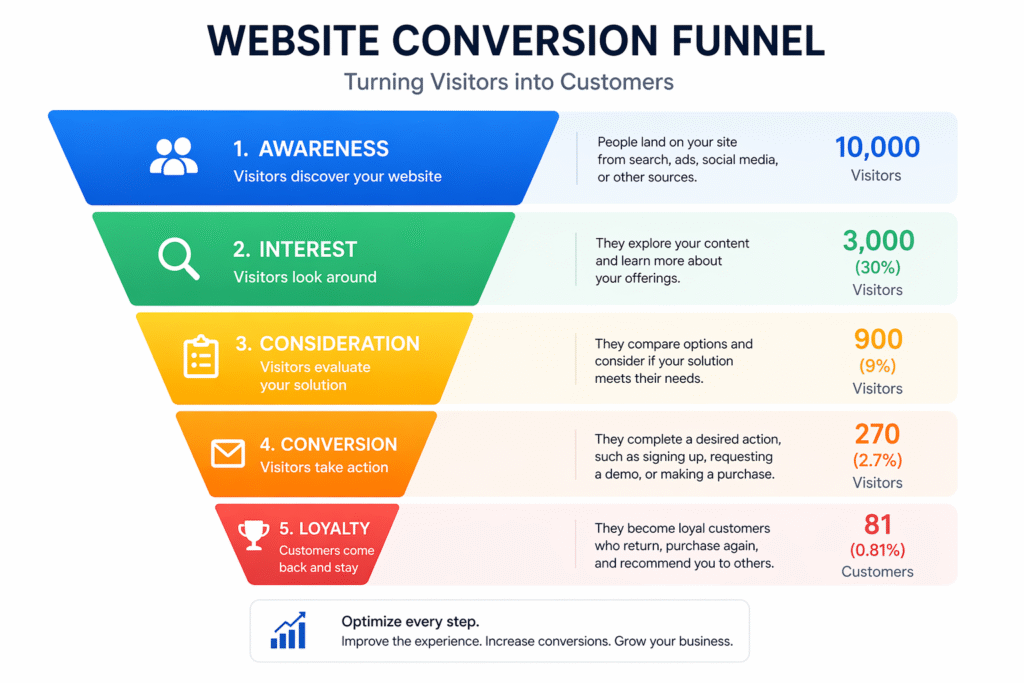
Driving traffic to your website is only part of the equation. The real challenge lies in turning those visitors into paying customers. As competition intensifies across digital channels, businesses are increasingly focused on creating content that converts rather than simply generating clicks.
In 2026, successful brands understand that conversion-focused content combines psychology, personalization, user experience, and strategic messaging. Whether your goal is lead generation, online sales, or customer acquisition, understanding how content influences purchasing decisions is essential for sustainable growth.
In this guide, we’ll explore proven strategies that help businesses transform website visitors into loyal customers while improving engagement and revenue performance.
Many businesses invest heavily in SEO, paid advertising, and social media to attract visitors. However, traffic alone does not guarantee business growth.
Research from multiple digital marketing studies consistently shows that most websites convert only a small percentage of their visitors. Improving conversion performance often produces greater ROI than simply increasing traffic volumes.
Creating effective content that converts helps businesses:
The goal is to create content that guides users through their decision-making journey while removing barriers that prevent action.
Before creating content, businesses must understand why visitors arrive on their website.
Most users fall into one of three categories:
These users seek answers, education, or research before making decisions.
Examples include:
These users compare products, services, and solutions.
Examples include:
These visitors are ready to purchase or contact a business.
Examples include:
Understanding user intent is the foundation of how to convert website visitors into customers effectively.
Personalization continues to be one of the strongest conversion drivers in digital marketing.
Studies show that consumers increasingly expect businesses to provide relevant and personalized experiences based on their interests and behavior.
Effective personalization strategies include:
When users feel that content addresses their specific needs, they are more likely to engage and convert.
Trust remains one of the biggest factors influencing purchasing decisions.
Visitors often evaluate trustworthiness within seconds of arriving on a website.
Strong trust signals include:
Businesses that prioritize trust-building often experience significantly higher conversion rates than competitors that focus solely on promotional messaging.
A generic homepage rarely converts as effectively as a dedicated landing page.
A conversion optimized landing page should include:
The most successful landing pages focus on solving a specific customer problem rather than promoting every available service.
Interactive experiences help increase engagement while collecting valuable customer insights.
Examples include:
Interactive content keeps visitors engaged longer and helps businesses qualify leads more effectively.
This approach has become one of the easiest content conversions for B2C organizations seeking higher engagement rates.
Even exceptional content can fail without effective calls-to-action (CTAs).
Strong CTAs should:
Examples include:
Positioning CTAs strategically throughout the customer journey significantly improves conversion performance.
Modern consumers increasingly expect immediate assistance.
Industry research continues to show that real-time support improves customer satisfaction and purchasing decisions.
Effective conversational tools include:
These tools reduce friction while helping visitors find answers quickly.
For businesses seeking to improve seo conversion content, conversational experiences can also increase engagement metrics that support broader optimization goals.
Mobile devices continue to generate the majority of website traffic worldwide.
Yet many websites still deliver inconsistent mobile experiences.
Key mobile optimization practices include:
Poor mobile experiences often lead to lost conversions regardless of traffic volume.
Educational content remains one of the most effective methods of building trust and authority.
Examples include:
Rather than aggressively selling products, educational content helps users make informed decisions.
This strategy supports both organic visibility and long-term customer acquisition.
Many visitors leave websites without completing desired actions.
However, abandoned users can often be recovered through strategic follow-up campaigns.
Common recovery tactics include:
Research consistently shows that abandoned cart and remarketing campaigns produce some of the highest-performing conversion rates in digital marketing.
Successful conversion strategies rely heavily on testing and optimization.
Businesses should regularly analyze:
Continuous testing allows businesses to identify opportunities for improvement and maximize marketing efficiency.
A strong data-driven approach transforms content from a creative exercise into a measurable business asset.
Several content formats continue to outperform others when it comes to conversions:
Content Type | Primary Goal |
Case Studies | Build trust |
Video Content | Increase engagement |
Product Demos | Support purchasing decisions |
Comparison Guides | Reduce uncertainty |
Testimonials | Strengthen credibility |
Interactive Tools | Generate leads |
Webinars | Educate prospects |
Personalized Emails | Nurture conversions |
Combining multiple content formats often produces stronger results than relying on a single channel.
As AI and personalization technologies continue evolving, businesses will increasingly focus on delivering:
Companies that adapt to changing customer expectations will gain significant competitive advantages.
The future of content that converts lies in creating experiences that are personalized, helpful, trustworthy, and frictionless.
Content that converts refers to digital content specifically designed to encourage visitors to take desired actions, such as making purchases, submitting forms, or requesting consultations.
Businesses can convert visitors by improving personalization, building trust, optimizing user experience, using effective calls-to-action, and providing valuable content throughout the customer journey.
Case studies, product demonstrations, testimonials, educational guides, interactive tools, and personalized email campaigns often generate the strongest conversion performance.
Personalized experiences increase relevance, improve engagement, build trust, and encourage users to take action based on their specific needs and interests.
Businesses can improve conversions by focusing on user intent, optimizing landing pages, leveraging data analytics, implementing AI-driven personalization, and continuously testing content performance.
Converting website visitors into customers requires more than attractive design or increased traffic. Businesses must create strategic, customer-focused experiences that guide users through every stage of the buying journey.
As customer expectations continue to evolve in 2026, businesses that invest in high-performing content strategies will be better positioned for sustainable growth. Trajital US helps organizations develop conversion-focused digital experiences that turn website traffic into measurable business outcomes.
For more information or to discuss your digital marketing needs, reach out to us at. Let us help you achieve your business goals with our comprehensive digital marketing solutions.


Copyright © Trajital LLC – All Right Reserved 2025